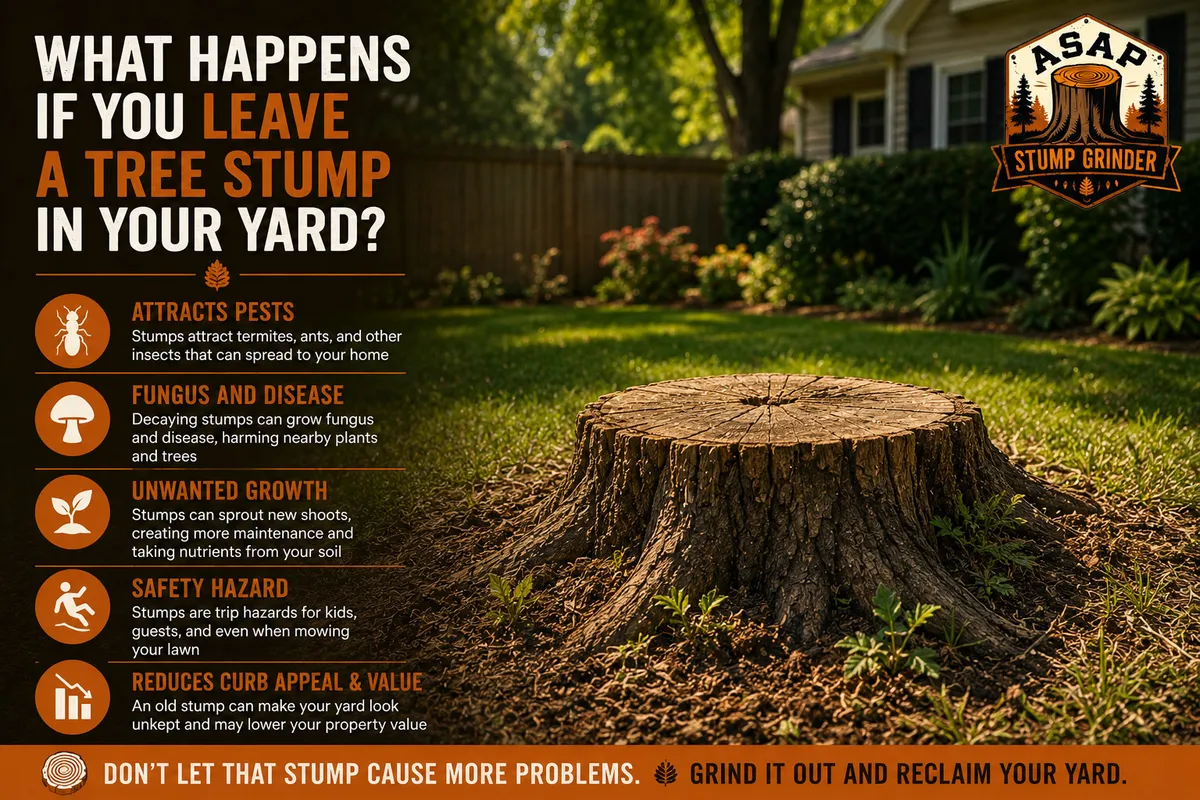
What Happens If You Leave a Tree Stump in Your Yard?
Ignoring a Stump Is a Choice With Consequences
After a tree is removed, the stump left behind can feel like a low-priority problem. It's not actively causing damage — at least not visibly — and plenty of homeowners decide to deal with it eventually. But eventually often becomes never, and in the meantime, the stump doesn't just sit there. It changes.
This post covers what actually happens when a stump is left in place, both over the short term and across several years. The progression is gradual enough that each stage feels manageable — until the cumulative cost makes itself obvious.
Year One: A Nuisance That Becomes a Habit
In the first year after a tree is cut, the stump is mostly a functional inconvenience. The wood is solid, the roots are intact, and decomposition has barely begun. The problems at this stage are about use and routine.
Mowing around the stump becomes a built-in inefficiency every time the yard is cut. If the stump sits close to grade, mower blades strike exposed wood or root flare, dulling blades and leaving uncut patches. Weed trimming around the base adds time to every maintenance session.
Some species — oak, elm, and sweetgum are common in Charlotte, NC — begin producing sprout regrowth from the stump base within the first growing season. Those sprouts pull nutrients from the root system and grow aggressively. Left uncut, they develop into multi-stemmed thickets that become progressively harder to manage without removing the source.
Years Two Through Four: Pest Activity and Decay Take Hold
As the wood begins to dry and soften, the stump becomes a different kind of problem. This is the stage where the consequences extend beyond the stump itself and start affecting the surrounding property.
Wood-Boring Insects Establish Colonies
Carpenter ants, termites, bark beetles, and wood-boring beetles are all drawn to decaying wood. They don't distinguish between a stump in the yard and the wood framing of a nearby structure. Stumps within fifteen to twenty feet of the house carry a genuine migration risk.
In Charlotte, NC, warm and humid summers support year-round insect activity that accelerates this process. The colonies don't appear all at once — they establish gradually as the wood softens, which means the stump can look intact from the outside while an active nest is already forming inside.
Fungal Decay Spreads Underground
Fungi break wood down through mycelial networks that extend well beyond the visible stump. As decay progresses, the same fungal species responsible for breaking down the stump can travel through root contact to nearby healthy trees. This is particularly relevant in Charlotte, NC yards where multiple mature trees grow in close proximity and share root zones.
Root rot fungi — including Armillaria species — infect living trees through underground root contact. Infected trees may show no symptoms for years, making the connection difficult to identify until the damage is already significant.
The Ground Above Begins to Sink
As the stump decomposes below grade, the soil above it settles and drops. What was a flush, chip-covered area starts to form a depression. For stumps with extensive lateral root systems, the root decay underground creates a network of voids that eventually surface as soft spots across a wider area of the yard.
Beyond Five Years: The Ground Becomes Unstable
Stumps left in place for five years or more typically show significant surface collapse. The area above the stump becomes a pronounced depression that collects water, promotes moss and fungal surface growth, and creates a walking hazard. Surrounding soil may have multiple soft or uneven patches from lateral root decay below grade.
By this stage, grinding is still possible — but it's no longer a simple job. The site work required to restore the ground after a long-neglected stump is more involved than it would have been in year one: more fill, more leveling, more seeding, and more time.
What a Neglected Stump Signals to Buyers in Charlotte, NC
A stump in the front yard reads as deferred maintenance to buyers and appraisers. It's a specific, visible item that home inspectors and buyers notice and note. It rarely reduces an appraisal by a specific dollar amount, but it contributes to the overall impression of a property that has not been actively maintained.
For sellers in the Charlotte, NC market, removing a stump before listing is one of the lower-cost improvements that removes a negotiating point before it appears on an inspection report. The cost of the grind is almost always less than the price concession it would otherwise justify.
Frequently Asked Questions
How long does a stump take to decompose naturally?
Full natural decomposition takes five to twenty years depending on species, diameter, climate, and soil conditions. Softwoods break down faster than hardwoods. Charlotte, NC's humid climate accelerates the process, but even under favorable conditions, full decomposition is measured in years — not months.
Can I speed up stump decomposition without grinding?
Potassium nitrate products accelerate fungal breakdown and can shorten decomposition to one to three years for smaller stumps. During that time, however, the stump still occupies the space, continues attracting pests, and produces the gradual surface collapse described above. Chemical treatment is not a substitute for grinding if using the space is the goal.
Do stumps always attract termites?
Not every stump draws termites, but decaying wood is one of the primary conditions they seek. Risk is proportional to proximity to the house and the stage of decay. A fresh, solid stump is lower risk. A partially decayed stump near the foundation is a meaningful one.
What if the stump is already heavily decayed?
Heavily decayed stumps can still be ground. The more important consideration first is whether fungal or pest activity has spread to adjacent plants or structures. A professional assessment before the grind helps identify what additional steps may be needed.
Is leaving a stump in place against any rules in Charlotte, NC?
There is no universal ordinance in Charlotte, NC requiring stump removal from private property. However, HOA rules, deed restrictions, or specific municipal provisions may apply depending on the neighborhood. If the stump creates a public safety hazard near a sidewalk or street, additional obligations may apply.
The Cost of Waiting vs. Acting
Leaving a stump in place is not a neutral choice — it's a choice with delayed and compounding costs. Pest risk, ground instability, spreading fungal decay, persistent regrowth, and accumulated lawn damage all grow the longer the stump sits. The grind doesn't get easier with time, and the site restoration required afterward gets more involved.
ASAP Stump Grinding provides professional stump grinding in Charlotte, NC for residential and commercial properties. Whether the stump is fresh or has been sitting for years, call (704) 975-0325 to schedule servic
