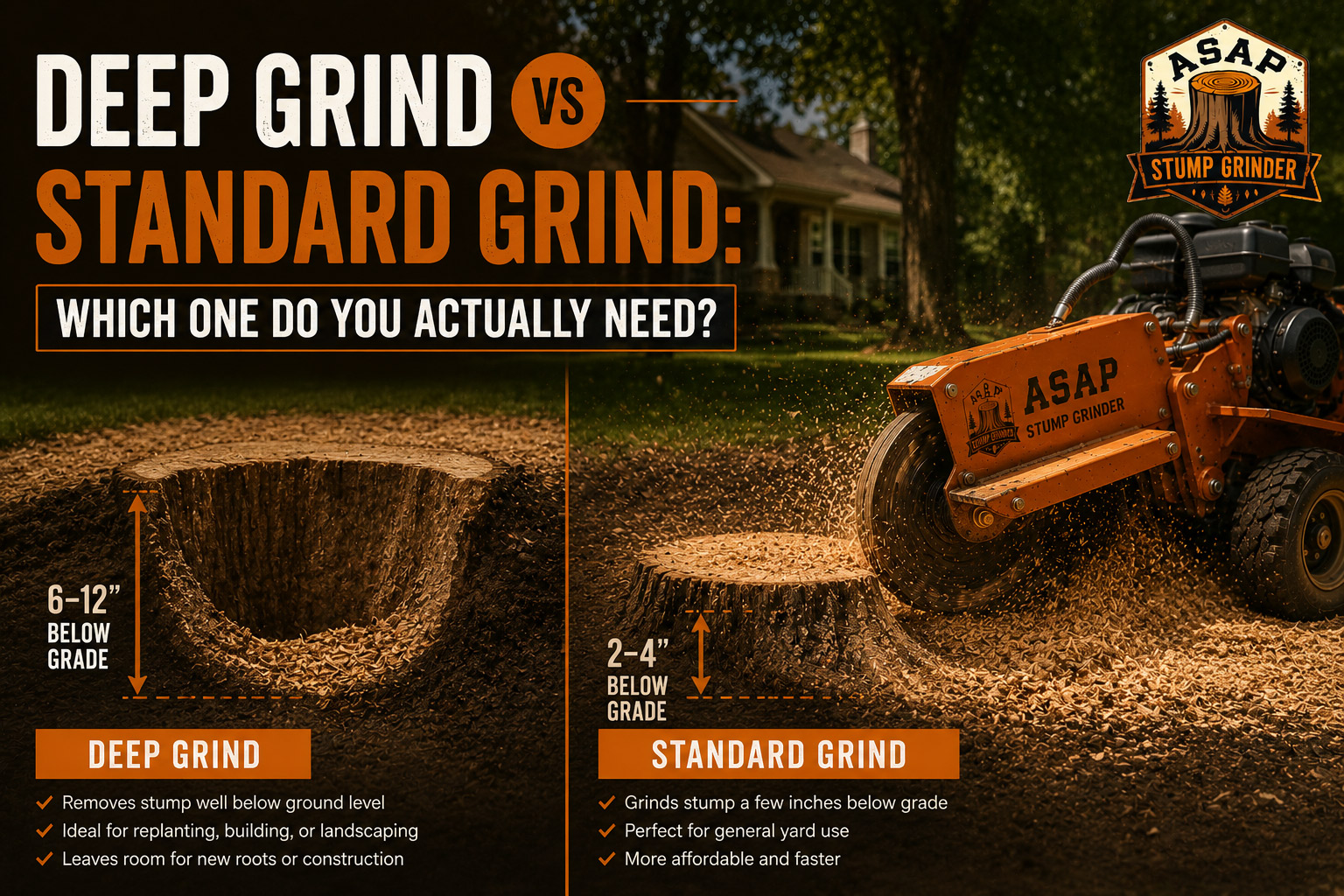
Deep Grind vs Standard Grind: Which One Do You Actually Need?
The Right Service Depends on What Comes Next
When you hire a stump grinding company, one of the first decisions is whether you need a standard grind or a deep grind. These aren't just names for how thorough the job is — they're genuinely different services designed for different outcomes.
Choosing the wrong one means either paying for depth you didn't need, or ending up with a stump that interferes with what you're planning to do with the space. This post explains the difference clearly and gives you a practical way to decide.
What a Standard Grind Covers
A standard grind takes the stump down to approximately six to eight inches below the soil surface. At that depth, the main crown — the wide, woody base from which the trunk grew — is fully shredded and removed. The lateral roots that spread outward through the soil remain in place and decay naturally over time.
Six to eight inches is enough to do two important things: remove the structural mass that was blocking use of the space, and put the grinding depth far enough below the surface that a lawnmower or typical landscaping work won't contact any remaining wood. You can add topsoil, seed with grass, and within a growing season have a normal lawn where the stump used to be.
For the vast majority of residential situations across Charlotte, NC, standard grinding is the correct service.
What a Deep Grind Covers
A deep grind goes twelve to twenty-four inches below grade. The goal is not just to remove the crown but to chase the vertical taproot downward and clear out as much woody material as possible within the stump's footprint. The result is a cavity substantially free of wood, giving a new root system room to establish in clean soil.
Deep grinding takes more time, causes more equipment wear, and costs more per stump. It's the right service when what comes next specifically requires it — not simply because going deeper feels more thorough.
Standard Grind vs Deep Grind at a Glance
The table below summarizes the key differences between the two services to help you quickly identify which applies to your situation.
How to Decide Which Service You Need
The cleanest way to make this decision is to ask yourself what you plan to do with the space after the stump is gone. Each answer points clearly to one service or the other.
1. You want to restore lawn or install a garden bed
Standard grinding is all you need. Six to eight inches removes the obstacle, and the remaining root structure below that depth decomposes without interfering with grass, ground cover, or shallow-rooted plantings. Charlotte, NC homeowners returning a stump area to lawn almost universally only need the standard service.
2. You want to replant a tree in the same footprint
This is the primary use case for deep grinding. A new tree planted over an old root system will compete with decaying wood for soil nutrients and have its root development restricted by the existing structure. Deep grinding removes as much of that material as possible, giving the new tree room to establish. For Charlotte, NC homeowners who want a specific species in a specific spot, deep grinding is not optional — it's what makes replanting viable.
3. You are installing hardscaping over the area
If a concrete pad, deck footing, or similar structure will be placed over the former stump location, decaying wood below standard grinding depth can eventually create a void as it breaks down. Deep grinding reduces that risk by removing more material before construction begins. Local contractors installing hardscaping in Charlotte, NC often specify deeper removal for this reason.
4. You are flexible about where a new tree goes
If you intend to plant a new tree but are open to placing it a few feet away from the old stump, standard grinding is sufficient. A new tree planted adjacent to — rather than directly over — the old footprint won't be competing with the root mass in the same way.
Frequently Asked Questions
Does deep grinding remove all the roots?
No grinding method removes all lateral roots — they extend too far and too wide to address with equipment. Deep grinding targets the vertical taproot and the crown, which is where the bulk of the structural mass is concentrated. Lateral roots are left in place regardless of grind depth.
How long does it take for roots to decompose after grinding?
Lateral roots from a typical residential tree decompose within three to seven years, depending on species, soil conditions, and moisture. Hardwoods take longer than softwoods. During that period, the roots don't typically cause surface problems.
Can I upgrade from a standard to a deep grind after the job is done?
Yes, but it requires a return visit and additional cost. It's far more efficient to decide before the crew arrives. If there's any possibility you'll replant in the same location, raise the question before the grind begins.
Should utilities be marked before a deep grind?
Yes — before any grinding job, standard or deep. In North Carolina, you can call 811 to have utility lines marked at no charge before work begins. Deep grinding goes further than standard, so confirming clearances is especially important.
Is root chasing the same as deep grinding?
No. Root chasing addresses the large lateral roots spreading horizontally across the yard surface. Deep grinding addresses vertical depth below the crown. Both can be added to the same job if the situation calls for it.
Make the Decision Before the Crew Arrives
The right choice comes down to one question: what's going in that space after the stump is gone? Lawn, garden beds, or simply clearing an obstruction — standard grinding handles it. Replanting in the exact footprint or placing a structure above — deep grinding is the right call.
ASAP Stump Grinding works with Charlotte, NC property owners to identify the correct service before the job begins. Call (704) 975-0325 to talk through your specific situation and get a quote.
